
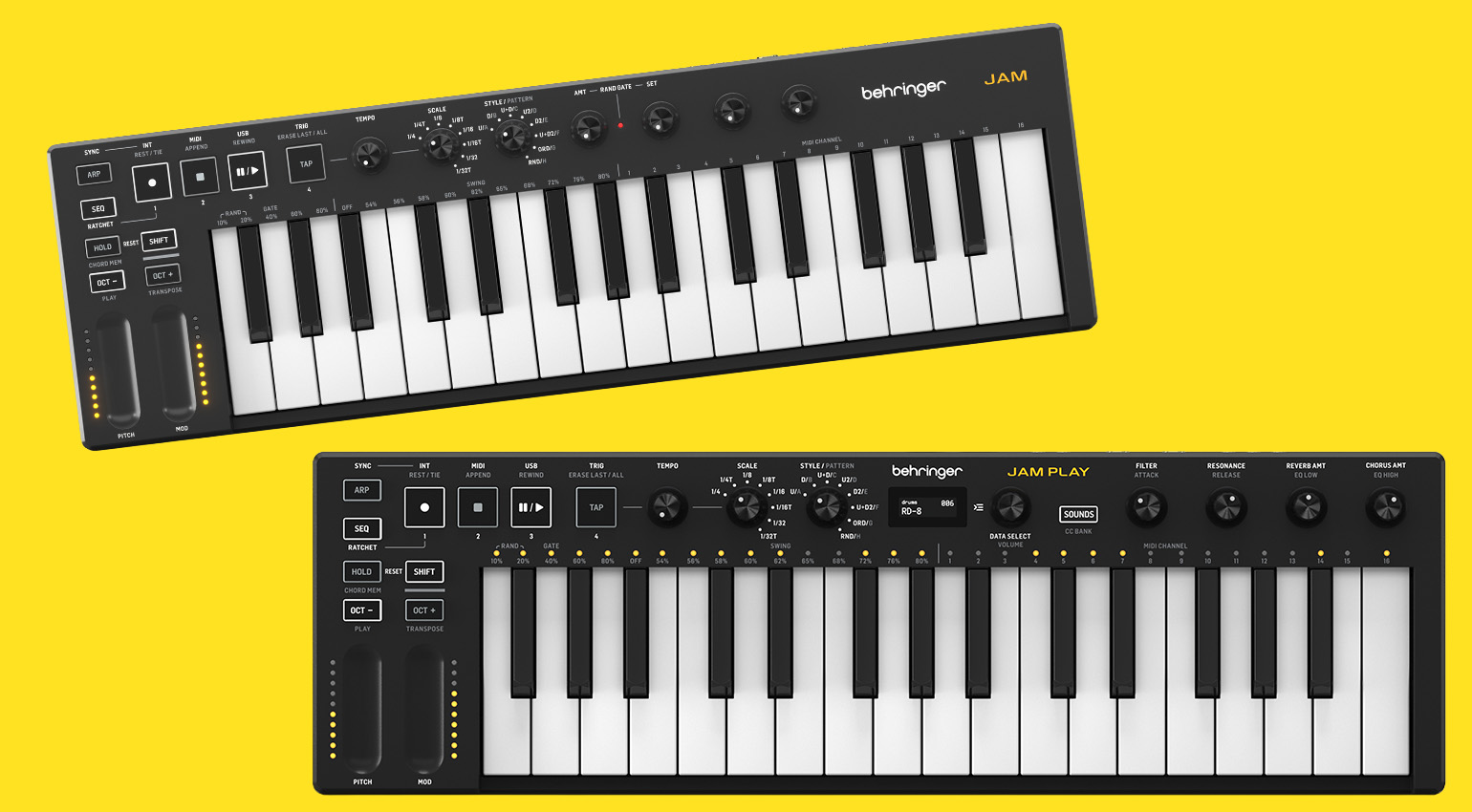
Behringer has introduced two new compact music production keyboards, JAM and JAM PLAY, featuring 32 velocity-sensitive keys, a 64-step polyphonic sequencer, advanced arpeggiator functions and connectivity for both digital and analog synthesizers.
Music technology manufacturer Behringer has expanded its range of production equipment with the introduction of JAM and JAM PLAY, two compact keyboard controllers designed for producers, electronic musicians and hardware enthusiasts.
Unveiled in October 2026, the new devices combine MIDI control, sequencing and performance functions in a portable format.
The products follow the company’s earlier Swing controller, introducing an updated design and additional creative features.
While both models share the same basic workflow, JAM PLAY introduces an important difference: built-in instrument sounds that allow musicians to create music without relying entirely on a computer.
The announcement adds two new options to the competitive market for affordable MIDI keyboards and hardware sequencers.
32 Keys and a 64-Step Polyphonic Sequencer
Both JAM and JAM PLAY feature 32 compact keys with velocity sensitivity and aftertouch.
This allows musicians to control different aspects of a performance through playing dynamics and pressure.
The keyboards also include touch-sensitive strips for pitch and modulation, alongside four assignable rotary controls.
One of their main features is a 64-step polyphonic sequencer capable of handling four sequencing channels.
The system supports up to eight notes of polyphony and includes functions such as legato, note ties, ratcheting and randomized gate behavior.
For electronic music producers, these features can help create evolving rhythmic patterns, melodic sequences and more complex arrangements.
The ability to program multiple channels also makes the devices useful for controlling different instruments within a hardware setup.
Advanced Arpeggiator and Chord Creation Tools
Behringer has equipped both models with creative functions aimed at simplifying musical experimentation.
The arpeggiator includes eight different modes, allowing musicians to create repeating note sequences with different directions and patterns.
A dedicated Chord Play mode supports chords containing up to 16 notes.
These capabilities can be particularly useful when producing house, techno, trance and other electronic genres built around repetitive melodic patterns.
The sequencer’s rhythmic functions can also introduce variations to otherwise static patterns, helping producers explore new ideas without programming every note manually inside a DAW.
For musicians using software such as Ableton Live, FL Studio or other MIDI-compatible production environments, the controllers offer an additional hands-on approach to sequencing and arrangement.
JAM PLAY Introduces 128 Built-In Sounds
The most important difference between the two models is the sound engine included in JAM PLAY.
While the standard JAM operates as a MIDI controller and sequencer, JAM PLAY can also function as a standalone electronic instrument.
It features 128 onboard instrument sounds, 10 drum kits and integrated effects.
A small display allows musicians to browse presets and adjust available parameters.
The device also includes a dedicated audio output for sending its internal sounds to external equipment.
This makes JAM PLAY particularly interesting for producers who want to develop ideas without immediately connecting a laptop.
Musicians can experiment with melodic patterns, drum sequences and chord progressions using the device’s internal sounds.
The ability to work independently from a computer provides additional flexibility for portable production setups and hardware-based live performances.
However, Behringer has not yet fully detailed the sound engine’s underlying technology or its editing capabilities.
Designed for Hybrid Studios and Analog Synthesizers
Both controllers provide connectivity for traditional MIDI equipment and modern modular synthesizers.
Alongside USB connectivity, the devices include five-pin MIDI connections, CV/Gate outputs and analog synchronization options.
These features allow producers to integrate the controllers with a range of external instruments.
For example, a musician could use the sequencer to control an analog bass synthesizer while sending MIDI information to another instrument or a computer.
The synchronization functions also make it possible to coordinate sequences with compatible drum machines and other hardware.
This hybrid approach reflects the increasing popularity of combining software production with physical instruments.
Instead of working exclusively inside a DAW, musicians can interact directly with synthesizers, sequencers and hardware effects.
Price and Availability
Behringer has not yet confirmed comprehensive global pricing and availability details for both products.
However, European retailer listings indicate that JAM is available for preorder at approximately €99, while JAM PLAY is listed at around €179, with prices varying between stores.
The relatively accessible pricing places both products within reach of beginner and intermediate producers, while their MIDI and CV connectivity may also appeal to more experienced musicians.
The standard JAM is positioned as a compact sequencing and control solution.
JAM PLAY offers a more independent production experience through its additional onboard sounds and drum kits.
A New Option for Electronic Music Producers
The introduction of JAM and JAM PLAY reflects continued interest in compact hardware that supports spontaneous music creation.
Sequencers, arpeggiators and chord-generation functions have become increasingly common in modern electronic music production, allowing artists to develop musical ideas through experimentation rather than conventional note-by-note programming.
For house and techno producers, hardware controllers can provide a practical way to create basslines, melodic loops, drum patterns and evolving arrangements.
Behringer’s latest devices bring several of these functions together in two portable keyboards.
With 32 keys, a 64-step sequencer and extensive hardware connectivity, JAM and JAM PLAY offer two approaches to electronic music production: one centered on controlling external instruments and software, and the other incorporating onboard sounds for standalone experimentation.
The new controllers join Behringer’s growing catalogue of affordable music technology products, offering additional options for producers looking to expand their creative workflow.
Conversation